Busan Weekend Itinerary: 2 Days by KTX From Seoul
Updated
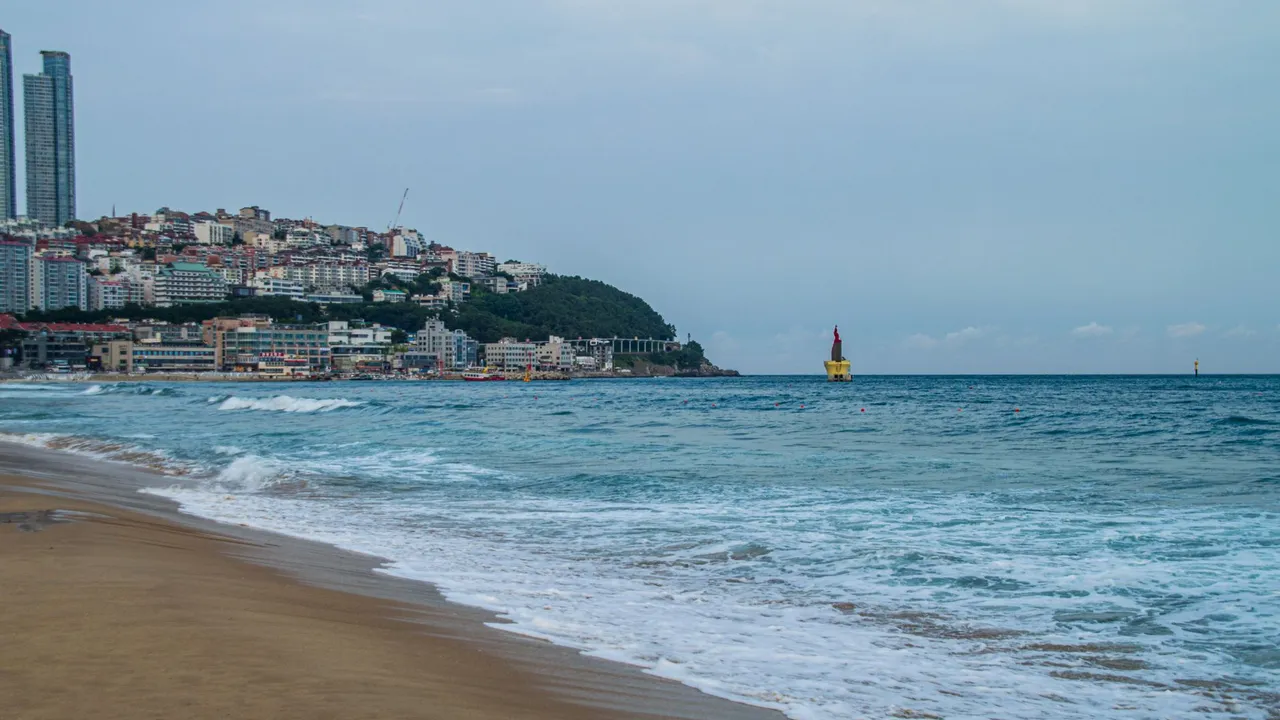
Photo by Saksham Vikram on Pexels
This plan spends one night in Busan after the KTX (Korea’s high-speed train) from Seoul: Haeundae Beach, Blueline Park and Gwangalli Beach at night on day one, then Haedong Yonggungsa temple, Gamcheon Culture Village and Nampo-dong on day two. The table below compares it with a day trip and a third day.
Day trip, one night or two: what does each come to?
| Plan | What it comes to |
|---|---|
| Day trip | At least about four and a half hours of the day on the KTX, round trip |
| 2 days / 1 night | The plan below: Haeundae Beach, Haeundae Blueline Park and Gwangalli Beach at night, then Haedong Yonggungsa, Gamcheon Culture Village and Nampo-dong |
| 3 days / 2 nights | The plan below, plus one of the extra-day options in the third-day section below |
How do you get from Seoul to Busan by KTX?
At the fastest, Seoul to Busan takes about 2 hours and 18 minutes by KTX. The time varies by train, so check the journey time shown for the train you actually book.
Since September 1, 2026, Korail and SR Corporation have run Korea’s high-speed trains as a joint operation. The SRT name has disappeared and all high-speed trains now run as KTX, and existing KTX fares were lowered by an average of 10% to match SRT levels. The Seoul-Busan KTX fare went from ₩59,800 to ₩54,400.
Booking is unified in one app, Korail+, and one search there covers trains leaving both Seoul Station and Suseo Station. Menus may differ by app version. Tickets are also sold at station ticket offices and ticketing kiosks and on the Korail website (korail.com), which is available in English and several other languages.
| Seoul Station | Suseo Station | |
|---|---|---|
| Where it is | The starting point of the Gyeongbu Line, served by Seoul Subway Lines 1 and 4, the Gyeongui-Jungang Line and AREX (Airport Railroad) | Seoul Suseo Station |
| Trains to Busan | KTX departs from here on routes that connect to Busan | Trains to Busan; they used to carry the SRT name and now run as KTX |
| Trains a day, arriving and departing, since the integration | 270 on weekdays, 313 on weekends | 132 on weekdays, 144 on weekends |
From October 1, 2026, KTX tickets can be booked up to two months before departure, up from one month. Confirm the current window in Korail+ when you book.
Busan Station is the end of the Gyeongbu Line, and Busan Metro Line 1 stops there.
What should you expect in each season?
| Season | What to expect |
|---|---|
| Spring (Mar-May) | Average 13.3°C; chilly when the wind blows from the northeast |
| Rainy season, nationwide (end of Jun-end of Jul) | Check the forecast in advance; the Beach Train and Sky Capsule run normally on rainy days, but may stop for heavy rain or typhoon |
| Summer (Jun-Aug) | Humid and hot, with localized torrential downpours in Busan; average 23.6°C. Haeundae Beach’s 2026 season opened on June 26 and drew more than 10 million visitors |
| Typhoon season, nationwide (Jun-Oct) | The Beach Train and Sky Capsule may stop for natural disasters such as heavy rain or typhoon |
| Autumn (Sep-Nov) | Average 17.2°C; often clear, with a large difference in temperature between day and night; typhoons might occur |
| Winter (Dec-Feb) | Windy, cold and dry; average 4.7°C |
Day 1: the coast-first route
From Busan Station, take Busan Metro Line 1 to Seomyeon Station, change to Busan Metro Line 2 there, and ride to Haeundae Station. Seomyeon is where you change lines anyway, which is why this plan puts lunch there (see the food section below).
Haeundae Beach and Dongbaekseom Island
Haeundae Beach is a 1.5 km stretch of white sand, a 15-minute walk from Exit 5 of Haeundae Station on Busan Metro Line 2. Walk all the way along the beach and you reach Dongbaekseom Island, which is now connected to the mainland by a bridge and holds the Dongbaek Coastal Trail, an easy walking path through forest.
Blueline Park: Beach Train or Sky Capsule?
Blueline Park has two different rides, the Beach Train and the Sky Capsule. They do not cover the same stretch: the Beach Train runs round trips on the Mipo-Cheongsapo-Songjeong section, while the Sky Capsule runs one way through the Mipo-Cheongsapo section. As of November 2026, the ride details and fares are as follows.
| Beach Train | Sky Capsule | |
|---|---|---|
| Route | Round trips on the 4.8 km Mipo-Cheongsapo-Songjeong section, with stops in between | One way through the Mipo-Cheongsapo section |
| Ride time | About 25 minutes one way, at 15 km/h; 3 one-way trips an hour | About 30 minutes |
| Fare | Per person: ₩10,000 for a single ride from Mipo or Songjeong, ₩8,000 from Cheongsapo, ₩14,000 for two rides, ₩16,000 for all stops | Per Sky Capsule: ₩50,000 (2 people), ₩55,000 (3), ₩60,000 (4) |
| Seats | No designated seats; standing is allowed | Up to 4 passengers; the same space whether 2, 3 or 4 ride |
| Booking | Online, the earliest train you can buy is two hours ahead; on-site tickets if seats remain | The reserved time is an entry window, not a departure time; early boarding is not allowed |
Online tickets for a given week (Monday to Sunday) open on Tuesday at 07:00, four weeks ahead. Apart from online tickets, a small amount of on-site tickets are sold at the ticket office first come, first served, and they may sell out early. Some overseas cards may not be accepted for payment because of a change in authentication method. Refunds shrink as the date approaches: 100% three days before, 80% two days before, 70% one day before and 50% on the boarding date, and no cancellation or refund is possible once the reserved time has passed. Booking screens may differ by site version.
The Beach Train runs from 09:00 at Mipo and Songjeong, closing at 19:00 from November to February, 19:30 in March, April and October, 20:30 in May, June and September, and 21:30 in July and August.
The Sky Capsule runs from 08:30, closing at 18:00 from November to February, 18:30 in March, April and October, 19:30 in May, June and September, and 20:30 in July and August.
Hours can change at extreme peak times or for safety, and boarding times can change on weekends and holidays, so check the day’s times when you book.
Mipo Station is about a 15-minute walk from Exit 7 of Jungdong Station on Busan Metro Line 2. For buses to Mipo Station, general buses 39, 100, 139, 141 and 200 and express bus 1003 serve the Mipo / Muntan Road entrance stop, about a 10-minute walk away.
Gwangalli at night: what do you actually do there?
Gwangalli Beach is a well-known Busan beach near the city center. When night falls the seafront is lit up, and the lighting on Gwangandaegyo Bridge changes color every second. From Exit 5 of Gwangan Station on Busan Metro Line 2 it is a 13-minute walk.
The Gwangalli M Drone Light Show is held weekly on Saturdays, so if you arrive on a Saturday, it falls on this first evening. The drone-only show lasts around 12 minutes and can be viewed from anywhere along Gwangalli Beach.
The laser-and-drone format on the first and third Saturdays of the month is longer. Showtimes are 20:00 and 22:00 from March to September and 19:00 and 21:00 from October to February.
The show may be canceled or delayed for rain, strong wind or typhoon, so check the schedule the week you go.
For food and drink there are raw fish (hoe) restaurants on Millak Fresh Fish Street and in the Fresh Fish Town at the end of the beach, cafes with an open view of Gwangandaegyo Bridge, and microbrews.
Haeundae or Gwangalli: how do the two beaches compare?
| Haeundae | Gwangalli | |
|---|---|---|
| Subway | Haeundae Station (Busan Metro Line 2), Exit 5 | Gwangan Station (Busan Metro Line 2), Exit 5 |
| What is there | 1.5 km of white sand, Dongbaekseom Island and the Dongbaek Coastal Trail | The lit seafront and Gwangandaegyo Bridge at night, sea-view cafes, raw fish restaurants |
| Bus to Haedong Yonggungsa | Bus 181, 100 or Haeundae 9 from Exit 7 of Haeundae Station | Busan Metro Line 2 from Gwangan Station to Haeundae Station, then the same buses |
One night: what is close by in each area?
| Area | Close by |
|---|---|
| Haeundae | Haeundae Beach, and the buses to Haedong Yonggungsa from Exit 7 of Haeundae Station |
| Gwangalli | The lit seafront and Gwangandaegyo Bridge at night, and the Saturday drone show |
| Seomyeon | Seomyeon Station on both Busan Metro Line 1 and Line 2, and Seomyeon Local Food Street near the station |
| Busan Station | The KTX terminus, on Busan Metro Line 1 |
Which Busan foods are on this route?
Four Busan foods sit on this route. In Visit Busan’s 2020 website survey (571 Korean-language respondents, 140 respondents in the English, Chinese and Japanese versions), dwaeji-gukbap (pork and rice soup) ranked first with both Korean-language and foreign-language respondents, milmyeon (wheat noodles) second with the Korean-language group, and ssiat hotteok (seed-filled pancake) second and seafood third with the foreign-language group.
Dwaeji-gukbap in Seomyeon
Busan is known as the “city of dwaeji-gukbap”. After the 1970s, large-scale pig farms raised pork production and made pork cheaper than beef, and Busan residents came to see the soup as both “Korean fast food” and “soul food”. A 2019 Busan Ilbo survey found more than 700 restaurants that specialize in it. Near Seomyeon Station, Seomyeon Local Food Street (Seomyeon-ro 68beon-gil) has many of them. Songjeong Samdae Gukbap (33 Seomyeon-ro 68beon-gil, about 200 m from Exit 1 of Seomyeon Station) is open 24 hours.
The soup typically comes with kimchi, salted shrimp and chives. Add the chives, taste the broth with a spoon, then adjust the seasoning with chopped condiments, salted shrimp or salt.
Whether the rice comes already mixed into the soup varies by restaurant: some places serve it that way and others do not. If you are unsure, follow what the people around you are eating.
Milmyeon (wheat noodles)
Milmyeon is a Busan specialty with North Korean roots. The owner of Naeho Naengmyeon in Uam-dong, which says it is where milmyeon was reinvented, says his family, refugees who had run a restaurant in the North for 30 years, opened a noodle place in Busan in March 1953 and used wheat flour from American army supplies instead of costly potato starch. The dish comes either as mul milmyeon (in broth) or as bibim milmyeon (spicy). It is topped with strips of cucumber, radish and half a boiled egg. For mul milmyeon, take a sip of the broth first, then add vinegar and mustard sauce to taste. Hwangsan Naengmyeon, near Busan Station, was established in 1975.
Ssiat hotteok (seed-filled pancake) at BIFF Square
Ssiat hotteok is a griddlecake fried in oil until golden, cut in half and filled with roasted nuts. The original is sold along BIFF Square in Nampo-dong. BIFF Square was named in 1996, after renovations ahead of the first Busan International Film Festival, and is a 428-meter street that starts in Nampo-dong.
Jagalchi Fish Market: how does it work?
Jagalchi Fish Market is one of the largest seafood markets in Korea, selling both live and dried fish, and visitors can eat fresh raw fish right at the market. It is open 05:00-22:00 and closes on some Tuesdays of the month (the 1st, 3rd and 5th on Visit Busan’s page, the 1st and 3rd on the Korea Tourism Organization’s), so check before you go. The market is a 6-minute walk from Exit 2 of Nampo Station or Exit 10 of Jagalchi Station on Busan Metro Line 1.
In my experience, eating raw fish at a fish market generally goes like this: you choose the fish and pay for it, then pay a separate table-setting fee (sangchalimbi) at the place where you eat. Drinks are paid for where you eat.
For a dispute over a bill, the Korea Tourism Organization (KTO) takes tourist complaints by phone on 1330, the 1330 Korea Travel Helpline number, and online at touristcomplaint.or.kr.
Day 2: How do the temple, Gamcheon Culture Village and Nampo-dong fit before the train?
The opening hours set the order. Haedong Yonggungsa opens at 04:30 and Gamcheon Culture Village at 09:00, so the temple goes first, and the rest of the day runs along Busan Metro Line 1 toward Busan Station.
| Order | Stop | Getting there |
|---|---|---|
| 1 | Haedong Yonggungsa | Exit 7 of Haeundae Station, then Bus 181, 100 or Haeundae 9; get off at the Haedong Yonggungsa stop |
| 2 | Gamcheon Culture Village | Bus back to Haeundae Station, Busan Metro Line 2 to Seomyeon Station, change to Line 1 for Toseong Station or Goejeong Station, then a village bus from Exit 6 (routes below) |
| 3 | Nampo-dong: BIFF Square, then Jagalchi Fish Market | Line 1 to Nampo Station or Jagalchi Station |
| 4 | Busan Station, then the KTX | Line 1 to Busan Station |
Haedong Yonggungsa
Haedong Yonggungsa sits along the shoreline, on the coast of Gijang. It is open all year round, every day from 04:30 to 19:20 (last entry 18:50), and admission is free. First built in 1376, it was rebuilt in the early 1930s. On the way in there are 108 stairs through a pine grove. Inside the temple, lower your voice and use the side doors of the sanctuary; the front door is only for monks.
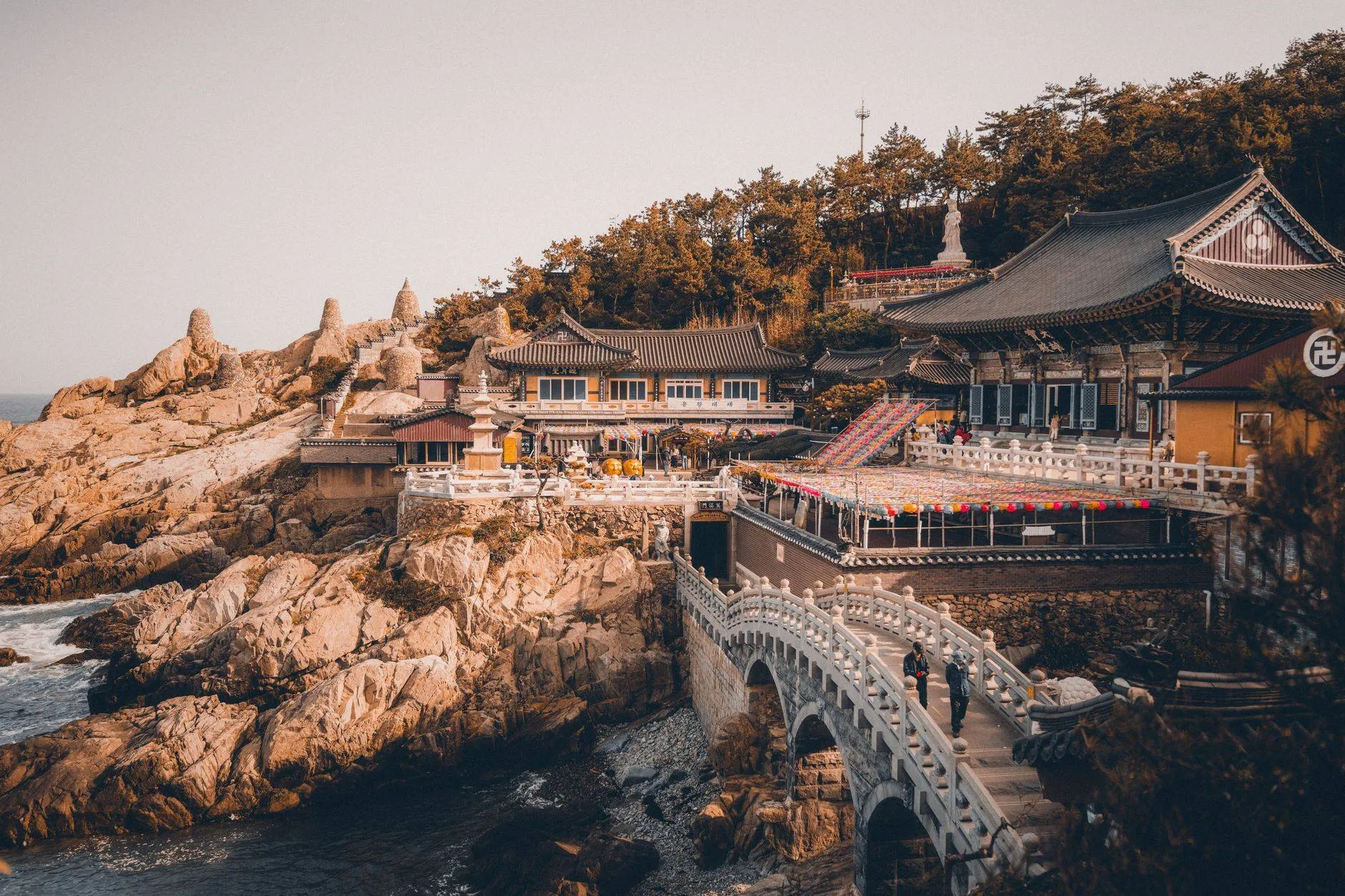 Photo by Andrea De Santis on Pexels
Gamcheon Culture Village
Gamcheon Culture Village is open throughout the year, from 09:00 to 18:00 in March-October and 09:00 to 17:00 in November-February. Entry is free apart from parking fees. From Exit 6 of Goejeong Station on Busan Metro Line 1, take village bus Saha 1 or Saha 1-1; from Exit 6 of Toseong Station, take Saha 1-1, Seo-gu 2 or Seo-gu 2-2. Get off at Gamjeong Elementary School and walk for 5 minutes.
Refugees settled here during the Korean War, and in 2009 students, artists and residents decorated the village as part of an art project. A stamp map is sold at the village information center. It is a residential area, so observe silence and cleanliness and do not use drones.
Getting around: T-money in Busan
Busan’s official transit pass is the Hanaro Card, but T-money, Cashbee and Mybi cards also get transfer discounts, which apply up to twice per trip when you transfer within 30 minutes. Hold the card to the fare reader on the way out of the bus or station. Metro transfer discounts apply only if you stay inside the subway platform, and the Airport Limousine gets none. For buying and loading one, see the T-money card guide. The Busan Metro operates from 05:00 to 23:59, with first and last trains varying by station. Larger suitcases or bulky items (over 50×40×20 cm or 20 kg) cannot go on the bus; use the subway or a taxi.
What if you have a third day, travel in winter, or bring kids?
- Day 3: The options closest to this route are riding the Beach Train to its last stop at Songjeong, walking the Dongbaek Coastal Trail on Dongbaekseom Island, or eating at Bupyeong Kkangtong Market, whose signature dish is bibim dangmyeon (spicy glass noodles) and which has many tteokbokki (spicy rice cakes) stalls.
- Winter: Plan around early closing. From November to February, Gamcheon Culture Village closes at 17:00, and the Beach Train and Sky Capsule run their shortest hours of the year (see the Blueline Park hours above).
- Kids: Beach Train and Sky Capsule tickets are free for infants under 36 months. A group of five normally splits into a 2 and a 3 for the Sky Capsule; the operator’s information and fare pages say five people including one child under 7 can take a four-person capsule, while its FAQ also mentions an infant under 36 months riding free, so confirm the conditions when you book. Strollers must be folded on both rides, and there are lockers at Mipo, Cheongsapo and Songjeong stations.