Seoul Subway Guide 2026: Fares, Cards, Apps, Last Trains
Updated
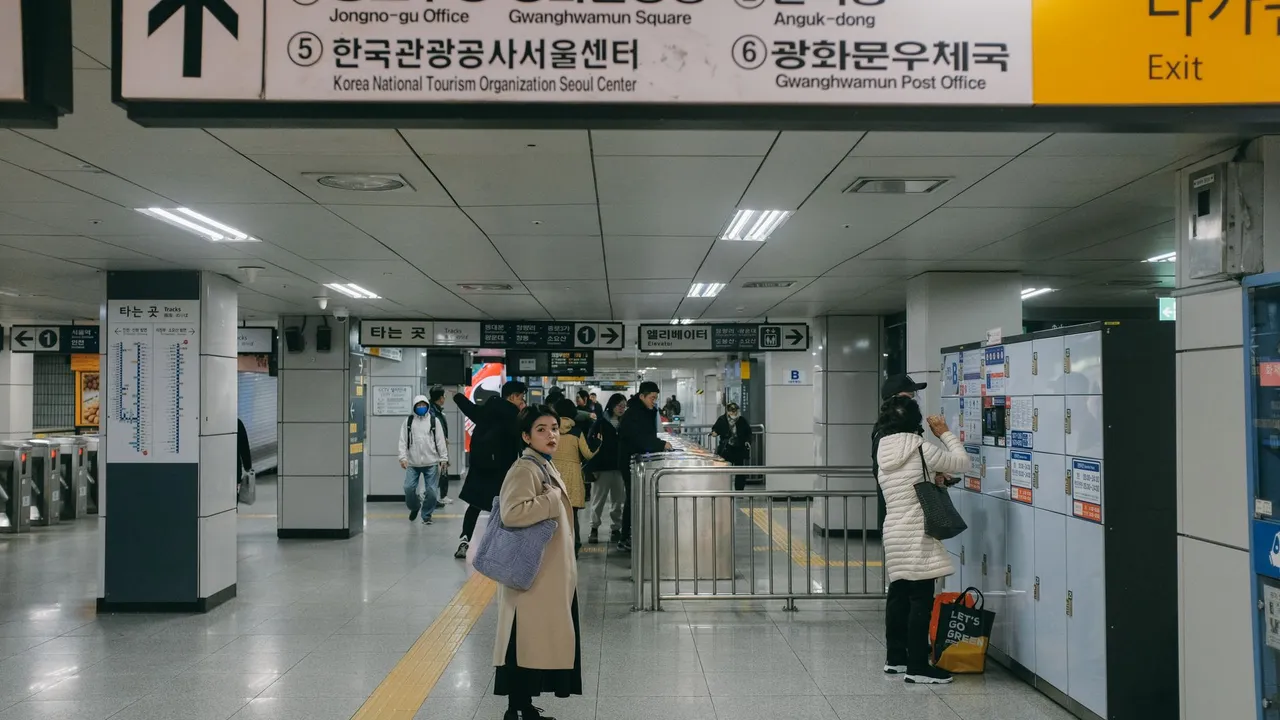
Photo by Huy Phan on Pexels
The Seoul subway is the piece of Korea I use the most and think about the least — it just works. It is also the piece foreign visitors ask about the most, and in 2025–2026 the answers changed fast: the base fare went up, the Climate Card was overhauled mid-2026, T-money landed in Apple Wallet, and the city started (slowly) opening up to overseas bank cards. This guide is the current, honest version: what your foreign card can and cannot do at the gate, what a ride costs now, which pass actually saves a visitor money, which apps to install, and how to not get stranded after the last train.
For scale: the wider Seoul metropolitan network runs 24 lines and over 1,300 km of track across more than 650 stations, reaching far beyond the city proper. You will not memorize it, and you don’t need to — a good app and a few habits cover everything.
Can you tap a foreign credit card on the Seoul subway?
Short answer, and it surprises people: no — not at the fare gate, not yet. Seoul’s gates run on Korea’s domestic payment system, which overseas credit cards don’t work with, so visitors still need a local transit card (T-money or a pass) to get through. The city has officially committed to “open-loop” payments — tapping a Visa or Mastercard directly at the gate, London-style — but on a phased timetable: payment infrastructure and bus terminals first (2025–2026), replacement of the gate terminals on Seoul subway Lines 1–8 in 2027, then expansion to town buses, private railways, and the wider metropolitan network through 2030.
What did change recently is the ticket machines. Since March 17, 2026, around 440 new kiosks across 273 stations on Lines 1–8 accept internationally issued Visa and Mastercard credit/debit cards (plus Kakao Pay and Naver Pay) — but only for buying Climate Card short-term passes (the 1–7 day tourist passes covered below) and single-journey tickets. An average service fee of roughly 3.7% applies to overseas-card payments.
Two limits worth being precise about, because most write-ups gloss over them. First, the announced kiosk scope covers only the Climate Card short-term passes and single-journey tickets — a regular T-money card is not on that list, so buying or topping one up with an overseas card still isn’t covered. Second, for everything past the kiosks, the city says it “plans to expand the payment system to regular transportation card readers beginning in 2027” — which lines up with the open-loop gate timeline above, and that first gate phase is scoped to Lines 1–8, not the entire metropolitan network.
The kiosks may grow a little more generous: the city has said that, depending on demand, it plans to extend the offering to the 30-day pass as well. But as of the most recent official announcements I could find (checked August 2026), the overseas-card scope is still passes and single-journey tickets — not regular T-money.
So the practical 2026 answer: bring your contactless card for the kiosk, not the gate. For the gate you still want a T-money card — our separate guide covers where to buy one and how to charge it — or a tourist pass from the table below.
How much does the Seoul subway cost in 2026?
The base fare is ₩1,550 with a transit card, after a ₩150 increase that took effect on June 28, 2025 across the whole metropolitan network (Seoul, Incheon, Gyeonggi and Korail-run lines). Teenagers pay ₩900 and children ₩550 with a card, and there’s an early-bird discount before 6:30 am (adults ₩1,240).
The fare is distance-based: the base fare covers the first 10 km, then ₩100 is added per 5 km beyond that. In practice most sightseeing hops inside central Seoul stay at or near the base fare.
A single-journey ticket from the machine costs ₩100 more than the card fare and takes a ₩500 deposit, which you reclaim at a “Deposit Refund Machine” at your destination station. It works, but queueing twice per ride gets old by day two — it’s the fallback, not the plan.
The quiet superpower of paying by card is the integrated transfer fare with buses: tap out, board a bus (or vice versa) within 30 minutes — 60 minutes between 9 pm and 7 am — and the system prices it as one continuous journey instead of two fresh fares. This is also why you should always tap out properly on buses: the distance-based system needs to know where your trip ended.
T-money, Climate Card, or a tourist pass — which should you get?
First, a 2026 status update, because older guides will mislead you: the famous monthly Climate Card (the ₩62,000 unlimited pass) is being discontinued in 2026 — the city’s current Climate Card page gives August 31, 2026 as the last day to recharge a 30-day prepaid card (an earlier city release had said July 31), and lists the card as formally discontinued on September 1, 2026 — in favor of a successor called Climate Card Plus, which is aimed at Seoul residents and, at the time of writing, still hadn’t fully launched.
The part that matters for a visitor survived: the tourist short-term passes (1, 2, 3, 5, and 7-day Climate Cards) continue to be sold without changes.
Prices: 1-day ₩5,000, 2-day ₩8,000, 3-day ₩10,000, 5-day ₩15,000, 7-day ₩20,000. One trap: validity starts the moment you charge the card — a 1-day pass charged at 8 pm expires that same day, not 24 hours later.
And the coverage fine print, which is where the Climate Card genuinely differs from T-money: it works on Seoul subway sections and Seoul-licensed city buses, but not on the Sinbundang Line, subway sections outside Seoul, or airport and intercity buses — and you can’t even tap out at a station beyond the coverage area if you boarded inside it.
| Option | Upfront cost | Where it works | Best for |
|---|---|---|---|
| T-money card | Card ₩3,000–5,000 depending on design (no credit loaded) + whatever you load (details) | Every gate, every line, buses nationwide, transfer discounts | Almost everyone — the safe default |
| Climate Card tourist pass (1–7 days) | ₩5,000 / ₩8,000 / ₩10,000 / ₩15,000 / ₩20,000 | Seoul subway sections + Seoul city buses only; no Sinbundang Line, no rides ending outside Seoul | Heavy sightseeing days concentrated inside Seoul |
| Single-journey tickets | Fare +₩100 per ride, +₩500 refundable deposit each time | Subway only | One-off rides; the machine now takes foreign cards |
One coverage note on the passes: the short-term tourist tiers cover subway and bus only — Ttareungyi (Seoul bike share) and the Hangang Bus are not included; those add-ons existed only on the discontinued 30-day tiers.
Honest break-even math: at the ₩1,550 base fare, a ₩5,000 one-day pass needs four or more rides in the day before it beats plain T-money — and any ride that strays outside the coverage area (a trip out to a Gyeonggi suburb, the Sinbundang Line to Pangyo) breaks it entirely. If your itinerary is palaces-markets-Hongdae inside Seoul and you genuinely ride a lot, the pass wins; for a mixed or relaxed itinerary, T-money’s flexibility usually wins.
Does Apple Pay or T-money on your phone work?
Real progress here, with one catch that matters for visitors. T-money has been available in Apple Wallet since July 22, 2025 — you can add a T-money card to iPhone or Apple Watch (iPhone XS/XR or newer on iOS 17.2+, Apple Watch Series 6/SE 2nd gen or newer) and tap the phone at the gate like locals do.
The catch: topping up inside Apple Wallet requires a credit or debit card issued in Korea. For a visitor without a Korean card, that undercuts the whole convenience — you can hold the card on your phone but not feed it from your home bank. A few modes (certain taxis, intercity buses) are also excluded from phone-based T-money.
Setup happens inside the Wallet app (adding a transit card); exact screens differ by iOS version and region settings, so treat any tap-by-tap tutorial you find online with suspicion — I’m deliberately not giving one.
Until the top-up story improves, the boring answer stands: a plastic T-money card charged with cash, or the tourist pass from a foreign-card kiosk, beats fighting your phone.
Which subway app should tourists use?
My honest, daily-rider answer is shorter than most listicles: I effectively use one app — Naver Map. Its routing quality and how quickly it reflects changes on the ground are why, and it’s what most Koreans around me are on too. For door-to-door navigation — walking, buses, “which exit do I take” — we’ve written a full setup guide for Naver Map and KakaoMap, including switching them to English, so I won’t repeat it here.
For the subway specifically, two dedicated subway apps are worth knowing as supplements:
- Subway Korea (Malang Studio) — tap-on-the-map route finder with real-time arrivals and timetables, English and Japanese interfaces, and coverage of Seoul, Busan, Daegu, Daejeon, and Gwangju.
- KakaoMetro (Kakao Mobility) — fastest-route search from the current time, and its party trick: it tells you which car to board so you step off right at the stairs for your transfer or exit.
(As everywhere in this guide: features and menus shift between app versions, so expect small differences from any screenshot you find.)
One local habit to steal regardless of app: navigate by station + line + exit number. That’s the actual unit of directions here — when I arrange to meet someone, the phrasing is “meet me at Gangnam Station, Exit 11” — almost never a street address — and the map apps lean into the same habit by routing your walking leg to the nearest numbered exit. Save all three parts together and the last 200 meters of every journey takes care of itself.
Where can you download the English subway map (PDF)?
The Seoul Metropolitan Government’s English site hosts a downloadable high-resolution English network map — the same diagram you’ll see on station walls — on its subway transportation page.
That said, a static PDF is best treated as a planning souvenir. The network gains stations and line extensions often enough that the map inside Naver Map, KakaoMap, or the subway apps above is almost always more current than any PDF you downloaded — and those also show you real-time arrivals, which no PDF will.
How do transfers work (and what is that jingle)?
Inside the subway network, transfers are free and invisible to your card: you follow the colored signs through the corridor to the other line without passing any gate, and you only tap again when you finally exit. The rule of thumb is simple — as long as you stay behind the gates, you’re on one fare. One caveat: a few lines charge their own supplement even behind the gates — the private Sinbundang Line adds ₩500–1,900 depending on the section, and the EverLine and U Line light rails add small flat charges. Leave through the gates, and your trip is over (the bus-transfer window from the fares section is the exception that softens this).
What the map doesn’t show is that “transfer” can mean anything from crossing a platform to a serious indoor hike with stairs. My personal benchmark for the bad end of the scale is Jamsil Station: switching between Line 2 and Line 8 there means a long corridor with no moving walkway, and it can be a genuine slog — with a suitcase, doubly so. Route apps show realistic transfer walking times; when two routes look equal, the one with fewer transfers is almost always the better ride.
And the jingle: on Lines 1–8, an instantly recognizable five-second burst of gugak (traditional Korean music) plays inside the train as you approach a transfer station — currently an arrangement of “Pungnyeon,” a gayageum (Korean zither) piece adopted in 2023 and refreshed again in January 2026 with more traditional instruments, produced with the National Gugak Center. Locals’ legs start moving on the first note; by day three, yours will too.
Its predecessor, “Eolssiguya,” played for 14 years after its 2009 introduction and was retired in early 2023 — long enough that it still triggers nostalgia posts from returning travelers.
What time does the Seoul subway close?
Earlier than many visitors expect. The system runs roughly 5:30 am to midnight, and the exact window varies by station and line.
Two concept-level rules will keep you off a 2 am taxi surge:
- The closing time is not your last train. Last departures start rolling well before midnight depending on where on the line you are and which direction you’re heading — the further your destination, the earlier your real deadline.
- Check your specific route in an app, not a poster. In Naver Map’s route search, the departures you can still catch are listed first, and when a departure is the day’s final service it carries a “makcha” (막차, last train) tag right on it; earlier in the day, opening a route’s transport detail shows the timetable, the last-train time, and the interval. (Menus may shift between app versions.)
Miss it anyway, and the fallback I’ve leaned on more than once is Seoul’s late-night Owl Bus network — city buses whose route numbers start with N (for “Night”) that keep running into the small hours on a limited set of corridors, at roughly 30–50 minute intervals and an adult card fare of ₩2,500. Naver Map shows them like any other bus — and it’s genuinely clever after hours: miss a train and it will sometimes route you on foot to a nearby station or stop whose last departure hasn’t left yet, or simply show you how long until the first morning train.
For a taxi instead, Kakao T is the app to have — Kakao Mobility held an overwhelming share of Korea’s taxi-hailing market (about 96% as of 2022, per the Korea Fair Trade Commission’s 2024 ruling), so it’s what the drivers themselves are on.
Subway etiquette: how locals actually ride
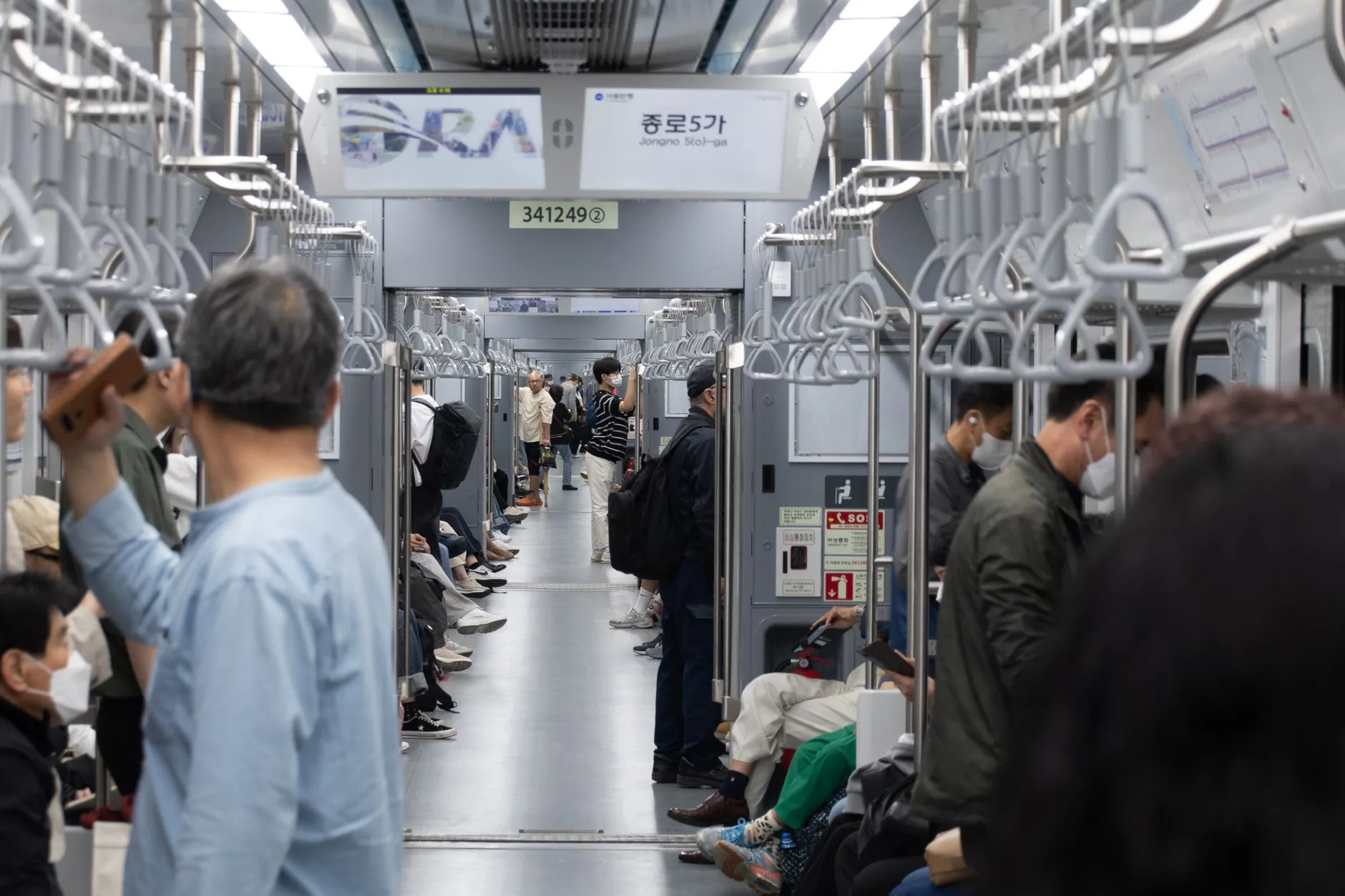 Photo by wal_ 172619 on Pexels
None of this is enforced; all of it is noticed.
- Priority seats are usually left empty, even in a packed car. Around 30% of subway seats are designated priority seating for elderly, disabled, and pregnant passengers — most locals will stand rather than sit in them.
- Let people off first. Stand aside at the door markings; board after the car empties.
- Big bags go in front of you or on the floor, not on your back in a crowd.
- No takeout coffee on buses — Seoul has banned riding buses with take-out coffee since January 2018, and the same instinct carries over to crowded trains.
The pink seats deserve their own line: two per car, mid-section, marked in pink down to the floor — priority seating for pregnant women, introduced in 2013. Whether they should sit empty when no pregnant rider is aboard is a genuinely live debate among Koreans (complaints about misuse run around 7,000 a year), which is exactly why a visitor should stay out of it: just don’t sit there.
Two habits you’ll only learn by watching, so let me save you the watching. On escalators, the practice is stand right, walk left — whatever the safety posters ask, that’s how the flow actually works. And on platforms, we queue on both sides of the screen doors, leaving the middle clear: the doors open, riders exit through the middle, and the two side queues flow in after them.
On crowding, my honest report as a daily rider: Lines 2 and 9 are the worst at commute hours, but they’re crowded pretty much always — don’t plan around finding a quiet window. If you’re stuck riding with a suitcase, board at a car’s end doors (the door positions numbered like 1-1 or 1-4 on the platform edge): the ends of each car are the one practical place to park luggage without blocking the flow.
Getting in from Incheon Airport (the short version)
The Airport Railroad (AREX) connects Incheon Airport to Seoul Station two ways: an express train running nonstop in about 40 minutes for ₩9,500, and an all-stop train departing every 5–10 minutes, taking just under an hour, for ₩4,150–4,750. With luggage or jet lag, the express is often worth the difference; otherwise the all-stop train is the workhorse. A dedicated Incheon Airport transport guide is coming — this post stays focused on the city network.
Five things to remember
- Your foreign card works at the new kiosks, not the gates — you still need T-money or a tourist pass to ride.
- Base fare is ₩1,550; a 1-day tourist pass only pays off from about four rides a day, and only inside Seoul’s coverage area.
- Install Naver Map — it’s the one app I actually use daily — and navigate by station + line + exit number.
- Check your last train per station and direction in the app — midnight on a poster is not your deadline.
- Priority and pink seats stay empty; people off first; bag in front. That’s 90% of blending in.
Ride it for a week and the network stops being infrastructure and starts being the city itself — which is exactly how locals experience it.